
Many engineering components operate under conditions that repeatedly change their shape, stress, or temperature. A rotating machine shaft bends slightly during operation, a metal bracket vibrates under changing loads, and a pressure vessel expands and contracts as operating conditions vary. Although these changes may seem minor, repeated exposure can gradually damage a material and eventually cause a crack or fracture.
Fatigue analysis services help engineers understand this type of long-term damage before it leads to equipment failure. By examining component geometry, material behavior, loading conditions, and operating environments, specialists evaluate fatigue resistance and estimate service life. This information is useful during product development, structural assessments, equipment upgrades, and investigations into damaged components.
Why Fatigue Matters in Engineering
Fatigue is a form of material deterioration caused by repeated or fluctuating stress. It differs from failure caused by a single overload because damage accumulates over many cycles. A component can therefore fail even when the stress in each individual cycle is lower than its yield strength.
The risk depends on several interacting factors. These include the size and frequency of the load, the material's fatigue properties, surface quality, component shape, and environmental conditions.
For example, a steel support exposed to continuous vibration may develop a crack near a welded connection. The connection may initially carry the required load, but repeated movement can gradually damage the surrounding material.
Understanding fatigue is important because visible deformation is not always present before a failure occurs.
What Happens During a Fatigue Assessment?
A professional fatigue assessment follows a sequence of engineering checks. The scope depends on whether the objective is to evaluate a new design, investigate an existing problem, or estimate the remaining life of equipment.
Reviewing Component Information
Engineers first examine available technical information, including CAD models, engineering drawings, material specifications, manufacturing details, and operating requirements.
The component's intended function is also important. A part exposed to continuous rotation requires a different loading assessment from a structure that experiences occasional lifting forces.
Where possible, operating measurements and maintenance records provide useful evidence about real-world conditions.
Establishing the Loading Conditions
Fatigue calculations require an understanding of how forces change over time. Common loading types include:
Repeated tension and compression
Alternating bending forces
Torsional loading in rotating shafts
Vibration from motors and machinery
Pressure cycles in tanks and pipelines
Thermal expansion and contraction
Some components experience several loading types at once. Engineers must consider their combined effects when the interaction is relevant to the design.
Locating Critical Regions
Stress is not always distributed evenly throughout a component. Holes, notches, sharp corners, threads, weld toes, and sudden changes in thickness can create local stress concentrations.
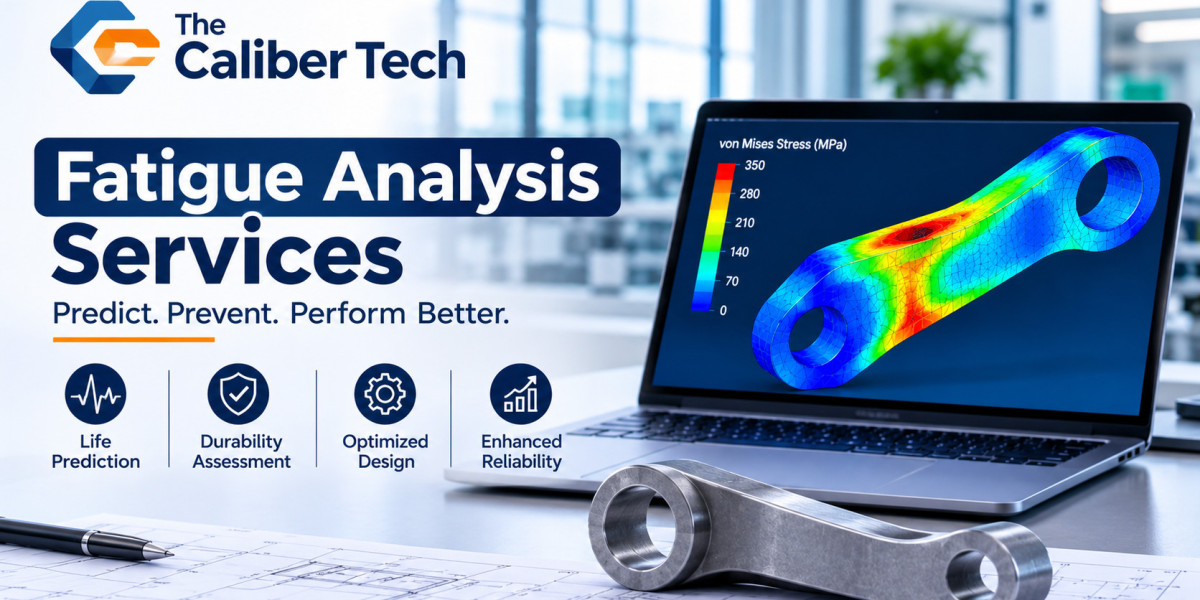
Finite element analysis (FEA) helps engineers examine these areas in detail. A properly developed model can show where stress or strain is elevated and which regions may require further fatigue evaluation.
Engineering Methods Used in Fatigue Analysis
No single calculation method is suitable for every fatigue problem. Engineers select an approach based on material behavior, loading severity, and the condition of the component.
Stress-Life Method
The stress-life method, commonly known as S-N analysis, relates cyclic stress amplitude to the number of cycles required to cause fatigue failure. Engineers use material S-N curves to estimate life under suitable loading conditions.
It is commonly applied to high-cycle fatigue problems where deformation remains largely elastic. The method is useful for many machine components and structural parts exposed to repeated operating loads.
Strain-Life Method
The strain-life method examines how repeated strain affects fatigue life. It is particularly useful when local plastic deformation occurs, such as around a notch or in a component exposed to severe cyclic loading.
This method considers both elastic and plastic strain effects. It can therefore provide a more suitable assessment when stress-life calculations alone do not represent the local material response.
Fracture Mechanics
Fracture mechanics is used when a crack or defect already exists or when crack growth is the main concern. Engineers evaluate how cyclic loading affects the crack and estimate whether it may grow to a critical size.
This method is relevant to welded structures, pressure equipment, aircraft components, and existing assets where inspection has identified a flaw.
Thermal Fatigue Assessment
Temperature changes can also produce repeated stresses. When a component heats and cools, different sections may expand or contract at different rates. If this movement is restricted, thermal stresses can develop.
Thermal fatigue assessment is important for exhaust systems, engines, industrial furnaces, heat exchangers, and other equipment exposed to repeated temperature cycles.
Industries That Use Fatigue Analysis Services
Fatigue assessment is used across industries where long-term performance depends on resistance to repeated loading.
Automotive and Vehicle Manufacturing
Suspension components, wheel hubs, chassis structures, engine brackets, and transmission parts experience changing loads during normal vehicle operation. Fatigue evaluation helps manufacturers assess durability under representative driving conditions.
Aerospace Engineering
Aircraft structures experience repeated flight loads, cabin pressurization cycles, vibration, and temperature changes. Fatigue assessment supports structural design, service-life evaluation, and inspection planning.
Energy and Power Generation
Turbines, generators, pumps, and rotating equipment operate under mechanical and thermal stresses. Fatigue analysis can help identify components that may require design changes or closer monitoring.
Oil, Gas, and Marine Engineering
Pipelines, offshore platforms, pressure vessels, and marine structures may face pressure fluctuations, wave forces, vibration, and corrosive environments. These conditions can increase fatigue damage, particularly around joints and welded details.
Industrial Manufacturing
Production machinery often operates for long periods with repeated motion and vibration. Assessing fatigue resistance helps manufacturers reduce component breakdowns and plan maintenance around equipment demands.
Practical Benefits of Fatigue Analysis Services
A reliable assessment provides more than a predicted number of operating cycles. It gives engineering teams information they can use to improve designs and manage equipment.
Early identification of weak points: Engineers can locate stress concentrations and review areas where cracks are more likely to begin.
Improved design decisions: Alternative geometries, materials, and connection details can be compared before production.
More effective maintenance planning: Fatigue estimates and inspection findings can help determine which components need monitoring or replacement.
Reduced development costs: Simulation can identify design problems before expensive prototypes or full-scale equipment are manufactured.
Better equipment reliability: Understanding fatigue behavior helps organizations make informed decisions about component selection, operating limits, and service intervals.
Support for failure investigations: When a part cracks or breaks, fatigue assessment can help determine whether repeated loading contributed to the damage.
Common Challenges and Important Considerations
Fatigue analysis can be sensitive to small changes in the information used. A prediction based on incomplete loading data or unsuitable material properties may not reflect actual component behavior.
One challenge is variable-amplitude loading. Equipment rarely experiences identical forces throughout its life. Engineers may use rainflow cycle counting to convert complex load histories into cycles that can be evaluated using fatigue methods.
Mean stress is another consideration. A component experiencing repeated tension around a high average tensile stress may behave differently from one subjected to fully reversed loading. Appropriate correction methods may be needed.
Manufacturing details can also affect fatigue performance. Weld quality, surface roughness, residual stresses, machining marks, and material defects may influence where cracks develop.
Environmental exposure should not be overlooked. Corrosion, moisture, temperature, and chemical contact can change material behavior and accelerate damage. In demanding applications, laboratory testing or inspection data may be needed to support simulation results.
Fatigue calculations also involve assumptions. Results should be reviewed by qualified engineers and interpreted alongside design requirements, operating history, and applicable engineering standards.
How to Choose an Engineering Analysis Provider
When selecting a provider, consider whether its technical capabilities match the component and the problem being investigated.
Relevant project experience: Look for experience with similar materials, equipment, and loading conditions.
Appropriate analysis methods: The provider should understand when to use S-N, strain-life, or fracture mechanics approaches.
FEA capability: Ask how models are developed, checked, and used in fatigue calculations.
Clear technical reporting: Results should explain assumptions, critical locations, fatigue estimates, and limitations.
Practical engineering advice: The final assessment should help guide design changes, inspection decisions, or maintenance actions.
A strong provider explains not only where fatigue damage may occur but also what can be done to manage the risk.
Frequently Asked Questions
1. What do fatigue analysis services evaluate?
They evaluate how repeated or fluctuating loads affect a component and estimate its resistance to fatigue damage over a defined period or number of cycles.
2. Can fatigue analysis be used for existing equipment?
Yes. Engineers can assess existing components using available design information, operating data, inspection findings, and suitable analysis methods.
3. Does FEA provide fatigue life directly?
FEA calculates stress and strain responses. These results can then be used with appropriate fatigue material data and calculation methods to estimate fatigue life.
4. What causes fatigue cracks to develop?
Cracks often begin at stress concentrations, surface imperfections, weld details, or material defects. Repeated loading can then cause the cracks to grow.
5. Can fatigue analysis improve product design?
Yes. It helps engineers identify vulnerable areas, compare design alternatives, select suitable materials, and improve resistance to repeated loading.
Conclusion
Fatigue damage is a gradual process that can affect components across nearly every engineering industry. Because it may develop without obvious early warning signs, evaluating repeated loading is an important part of designing and maintaining reliable equipment.
Fatigue analysis services help engineers assess material behavior, locate critical stress regions, estimate component life, and investigate potential crack growth. When supported by accurate data and appropriate engineering methods, these assessments provide practical guidance for improving durability, planning maintenance, and reducing the risk of unexpected failure.