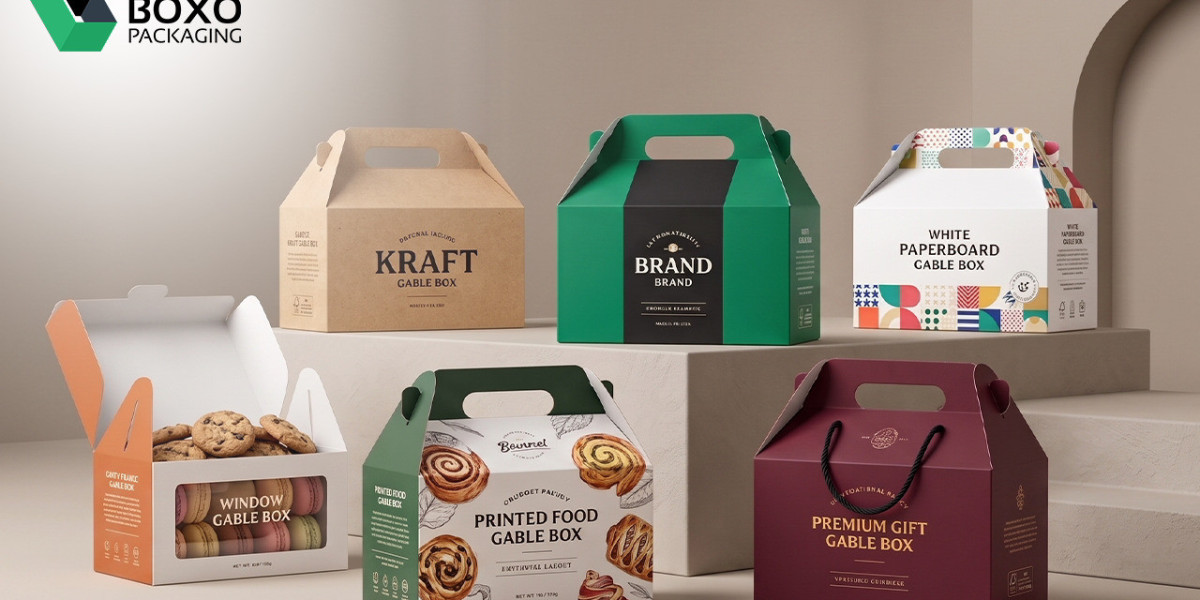

A handled carton can bring several components into one portable unit, provided its interior and closure suit the combined load. In Custom Gable Packaging, the peaked upper panels incorporate the carrying area above the main cavity. This makes the format worth considering for a collection handed directly to its buyer, rather than several products sold separately.
Take a gardening starter kit containing seed envelopes, plant markers, and a small empty pot. The contents have different shapes, so simply choosing a box around the largest item leaves the smaller pieces free to move. The useful design task is to establish where each component sits before adding the roof and handle.
Map the kit before drawing the outside
Lay the contents on a table in the intended arrangement. Measure the grouping, including protective wraps and any internal support. Then consider which objects could shift when someone lifts the carton at an angle.
A folded paperboard insert might hold the pot while a narrow compartment keeps the seed envelopes upright. That insert occupies space itself. Leaving it out of the first measurement can turn a workable arrangement into a tightly compressed package.
Inspect the initial mockup for four specific conditions:
- Plant markers should not rise into the upper locking area.
- The pot should remain separated from easily creased envelopes.
- The handle opening should be accessible with the roof closed.
- The loaded base should remain stable on a collection counter.
Partitioned gift boxes offer a useful alternative when the contents need a lower, wider arrangement. A corrugated carrier may deserve consideration if the completed kit needs greater structural support. Neither choice removes the need to test the real combination of items.
Treat the carrying trial as a design review
Lift the sample from the handle, walk with it, and place it down several times. Watch where the contents settle and where the board begins to flex. A static photograph cannot reveal those movements.
Do not assign a carrying capacity from the style name or paperboard appearance. The handle cutout, fold positions, base design, material, and load distribution interact. Changing the pot or adding a booklet can alter the result enough to justify another trial.
When preparing a brief for Boxo Packaging, include the full component set and explain the handover journey. A kit collected at a workshop faces a different route from one that will travel inside a parcel shipper.
For Custom Gable Packaging, the printed layout should reinforce the assembled kit rather than disguise how it opens. A clear contents description belongs on a panel that remains visible below the roof. A short assembly guide can sit inside, where it becomes useful after the recipient removes the components.
Custom Tuck Boxes for the Individual Products Inside a Range
A conventional tuck-end carton encloses an individual product with folding end flaps rather than an integrated carrying roof. With Custom Tuck Boxes, the main closures tuck into the body, while a glued side seam typically forms the tube. The format suits a shelf unit when portability is less important than product fit and a clear opening face.
Within the gardening range, a boxed pack of plant labels might be sold independently alongside the larger starter kit. Its packaging needs to identify quantity and product type quickly. It does not need to reproduce the kit's carrying structure.
Resolve the opening direction in the cutting guide
Straight tuck-end cartons have their main flaps closing in the same direction. Reverse tuck-end cartons close in opposite directions. That distinction describes flap orientation, not a universal ranking of strength or shipping suitability.
Ask to see the carton assembled with its intended front face upright. The opening edge should be easy to locate, and required information should not disappear onto a glue area or become interrupted by a flap fold.
A compact carton benefits from a precise sample review:
- Allow clearance for the product's thickest point or seam.
- Keep loose components away from the closing tongue.
- Check that the opening edge remains easy to grasp.
- Confirm that quantity information stays visible in shelf position.
A sleeve and tray may work better if the labels need to slide out as a stack. A hanging retail carton could suit a display rail, provided the hanging feature is designed and tested for the packed item. These are functional alternatives, not merely decorative variations.
Connect the small carton to the kit without copying it
Use consistent product naming and recognizable visual cues across the range. The individual carton can carry detailed use instructions, while the kit explains how its components work together. Repeating the same long description on both levels wastes space and can confuse the information hierarchy.
If the carton contains loose labels, check whether they rattle or catch under a dust flap. A simple internal band might control the stack more efficiently than filling unused space with tissue. Test removal as well as loading.
The specification for Custom Tuck Boxes should record interior dimensions, flap arrangement, packing sequence, and the expected presentation. Keeping those decisions separate from the handled kit structure lets each package do its own job while the range still feels coordinated.