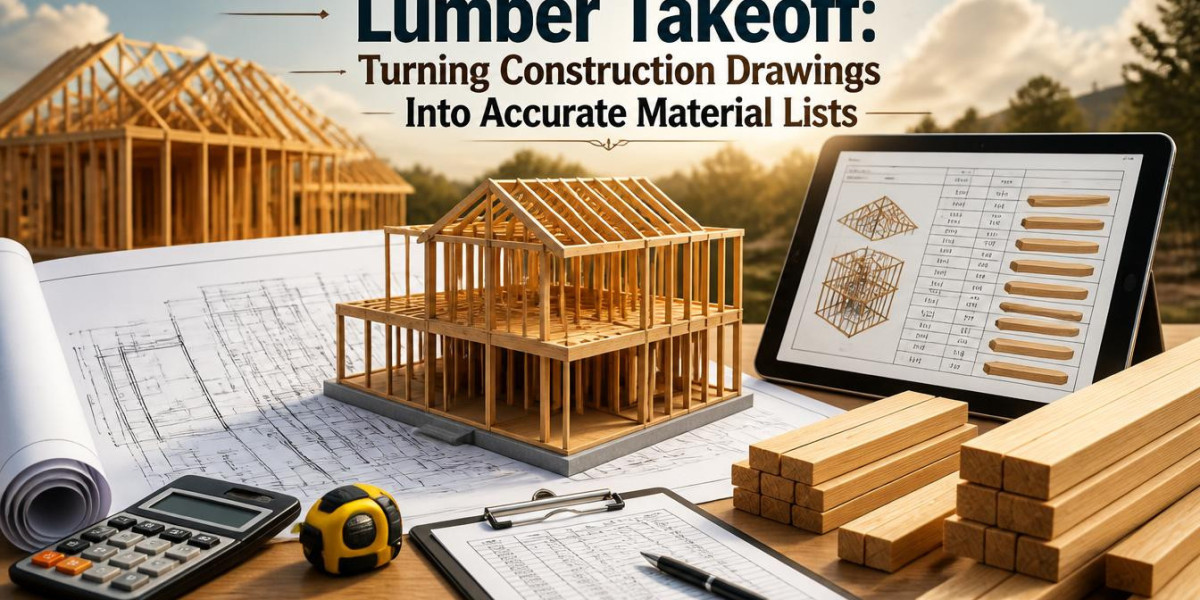

A framing crew priced a gable addition using a flat rate from a similar rectangular home. But the actual roof had six hips and two valleys. By the time framing was complete, the crew had used nearly 18% more lumber than the estimate allowed. This is exactly the kind of problem a proper lumber takeoff can help prevent.
SMA Estimating LLC’s lumber takeoff services count what the roof, walls, and floor system actually need. They do not base the count on what a similar project used.
Here is where takeoffs can go wrong and what helps keep the quantities accurate.
What Actually Goes Into An Accurate Lumber Takeoff?
This means counting all of the framing members, including studs, joists, rafters, headers, and sheathing. The count will be based on the construction drawings and not on how many square feet of framing is needed. Missing these details can cause the budget to increase later.
A proper takeoff separates construction material quantities by framing type. Wall framing, floor framing, roof framing, and sheathing are each separate line items. Combining it all into one rate would hide additional costs from complex rooflines or unusual wall heights.
Why Do Framing Takeoffs Go Wrong On Complex Rooflines?
Because hips, valleys, and dormers do not follow square footage in the same way as a simple gable roof. A flat rate assumes the framing is equally simple across the whole roof. Most roofs are not that simple.
Every hip and valley can require extra cuts, rafters, and lumber. It can also create more waste than a straight gable roof. Building drawings with complex rooflines need a member-by-member count under CSI Division 06 (Wood, Plastics, and Composites). Do not use an average based on a simpler roof.
How Volatile Are Lumber Prices Right Now?
Lumber prices can change more than many estimators expect. Even over a few months, price changes can affect the project cost.
Period | Softwood Lumber PPI (Index) | Change |
Dec 2025 | 250.2 | — |
Jan 2026 | 260.0 | +3.9% |
Feb 2026 | 270.3 | +4.0% |
Source: (U.S. BLS, PPI, via FRED)
That is roughly a 7.7% increase in softwood lumber prices in just two months (FRED/BLS PPI, 2026). A lumber takeoff prepared in December and not updated by February may already be using outdated prices.
What Role Does Waste Factor Play In Material Quantities?
It is the buffer between the amount calculated on paper and the amount that actually needs to be ordered. The amount of waste depends on the framing type. Ignoring it may make the crew run short on material during the build.
Straight wall framing usually needs less waste allowance than hip roofs, cut rafters, or irregular floor systems. These complex layouts create more offcuts. Sitework estimating teams and framing estimators know that a waste factor that works for simple gable framing may not be enough for a more complex roof or floor system.
How Does This Connect To The Rest Of Material Takeoff?
Lumber is rarely priced by itself. It is part of a broader construction material takeoff that also includes fasteners, sheathing, and connectors based on the same framing plan. A mistake in one quantity can affect the others.
Hangers, hurricane ties, and structural screws are sized and counted from the same framing member list. If the lumber count is wrong, the hardware order can be wrong too.
What Should A Takeoff Partner Actually Deliver?
A member-by-member count based on current prices is more reliable than a simple square-foot rate. If the takeoff does not match the actual roof and wall layout in the drawings, it is not a true takeoff.
SMA Estimating LLC counts each type of framing, adds the right waste factor for each type, and checks prices against current lumber data before adding them to the bid.
For the next framing package, ask one question: Does the takeoff match the actual roof and wall layout, or is it using a number from a simpler job?
Conclusion
Lumber takeoffs depend on two things: counting the actual framing and using current material prices. With softwood lumber prices moving nearly 8% in two months, an old takeoff can lead to a costly mistake. SMA Estimating LLC builds every takeoff from the actual drawings and current lumber prices. This helps contractors bid for what the project really needs, not what a similar job used before.